If you like my posts, get new ones emailed to you:
Happy end of 2025, y’all! I’ve read too much since my last linkpost in the spring to accurately give you everything I’ve read (moving from Chicago to New York and starting a new job haven’t helped), so I figured I’ll just dump things in here with a little less context. More posts hopefully coming soon!
Books
These are, of course, only highlights; I promise I’ve read more.
A few books I read provoked deep disgust. These include (but aren’t limited to):
- Cormac McCarthy’s Blood Meridian (how can we be so casually cruel? Judge Holden is the devil, but most of the novel’s cruelty is perpetuated by mere men.),
- Bea Sutton’s Berlin (how can we be so self-indulgently stagnant? it is not enough to know your problems, because they will recur while you wait for the world to save you. You must change your life, which might just finally kick me into reading Agnes Callard’s Aspiration).
- Joseph Conrad’s Heart of Darkness (how can we be so indifferent to the cruelty around us?).
Some books were just entertaining:
- I’m Starting to Worry About This Black Box of Doom (no spoilers, but I was surprised at how much I found myself agreeing with the woman shepherding the box: “While your news feeds were bludgeoning you with stories of school shootings, pathological politicians, and nonstop outrage, this war against the [guinea] worms was quietly won thanks to relentless, selfless effort by thousands of strangers.”),
- The Lies of Locke Lamora (per Mr. and Mrs. Psmith, “a roller-coaster ride that just. doesn’t. stop.”),
- Living to Tell the Tale (Gabriel Garcia Marquez is a character in his own novels),
- Dino Buzzati’s The Singularity (Every new concern is an old concern, and we must be careful trusting the machines, which do not love).
It’s also been interesting to look at politics and my new world through the lens of Nadia Asparouhova’s Antimemetics. Antimemetics starts by asking “why don’t good ideas spread?” It ends with a sorta Thiel-ey (thought not poorly-done) critique of modern bureaucratic democracy and an indictment of outward, Temu/Shien virus-like internet culture.
Asparouhova points out that an idea’s transmissibility is a function of both the idea’s properties (how easily it can be explained, the asthetics with which it’s presented, etc.) and the recipients’ properties (have we been inoculated against it, how much would we have to change if we accepted the idea, etc). She then turns around and uses this to engage with what she calls supermemes: ideas that’re easy to grasp and hard to let go. Wars. Climate change. Racial injustice.
This sort of modeling might make you a little more skeptical of mass politics — if our attention spans are so hijackable and if we so often ignore the big, important stuff, maybe we should trust democracies less. Indeed, Asparhouva makes certain Curtis Yarvin-ey political claims about the failings of democracy and governance by groupchat that I don’t think I endorse. On the other, I agree, though, that, wow, maybe we need some of what Ezra Klein calls “a modern temperance movement” for attention. Your focus is a jewel — a jewel so valuable that teams of software engineers scheme, Ocean’s Eleven-like, to keep you in the machine zone. The brightest minds of my generation, destroyed by adness!
Big Tech is, in many ways, using the antimemetic regulatory playbook of big tobacco. The move isn’t to outright deny that your technology could be bad, it’s to muddy the water. We need more research, we’re just asking questions. All while playing both sides and fighting any regulation stronger than “you have to disclose your terms of service.” Look how it ended for Phillip Morris.
Okay, zooming back out.
As I go into the dead zone between Christmas and the New Year, when nothing in politics ever seems to happen, I plan to read a few more things:
- Blindsight by Peter Watts (I hear it’s a good book!),
- Never Split the Difference and Getting to Yes. After doing some negotiating, I realized how much more I have to learn about negotiating. Step one!
- If I have some time, Fanged Noumena. A lot of the big anti-liberal and anti-Liberal folks I often find on the other side of policy debates (both about AI and what our society ought to look like) cite Nick Land, so I think it’s worth examining his ideas directly.
- Every single bill my boss has ever introduced.
Internet things
A Jury of Mirrors
When people who win one round get to decide who wins the next, you get weird long-run effects. Bodybuilders build bodies that attract bodybuilders instead of, y’know, women. Architects build for other architects. Nerds write for other nerds.
That Survivorship Bias Plane
Everybody knows the wikipedia image for survivorship bias — it’s a plane with those red dots:

But what’s the plane like IRL? Like what were the actual planes that inspired the operations researchers to redesign the plane armor? Yuxi Liu dives in.
Taking Jaggedness Seriously
Great piece by Helen Toner discussing the shape of AI capabilities and some implications of jaggedness: when AI is inordinately better than humans at some things and much, much worse at others.
If you watch the video version, see if you can spot me asking a question!
Romantic Love is an Under-Rated Driver of Gender Equality
I’ve really been enjoying Dr. Alice Evans’s blog, The Great Gender Divergence. I’ve been enjoying watching authors live-blog their books as they write them (see also e.g. In The Cells of the Eggplant and secondperson.dating, though of course there are others). The gist of this piece is exactly what it says on the tin, though: men who genuinely love women will advocate for them.
A great way to see this — as Dr. Evans lays out — is by examening patriarchial societies without much gender equality. Pretty much to a tee, it turns out, they suppress romantic love.
In Pakistan, men learn that their loyalties lie with their mothers, not their wives. Marriages are arranged and weak: you don’t spend much time with your wife, she doesn’t have much say. The problem is twofold. Patriarchial social norms keep women from being influential, and those norms also make it taboo for men to share power or time or love with their wives.
Europe and America, through Roman Christianity, the reformation, and into today, are certainly still male-dominated, but they’re meaningfully less so. Divorce, family planning, and increasing access to education mean that men and women together can prioritize love when they’re choosing who to spend the rest of their lives with. This is weird! On this account, romantic love as infrastructure for gender equality is deeply culturally contingent, not a universal that societies converge on. And it’s not clear what the policy lever is.
TLDR fight structural oppression by being a wife guy.
You Could’ve Invented the Transformer
Gwern walks forward through the history of NLP up to Attention is All You Need, trying to reconstruct the insights that led to the transformer. Ultimately, he concludes, “it is now ‘obvious’ that Transformers, or something like them, could work well, and how one could have invented them.”
Why Do East Asian Firms Value Drinking?
East Asian communication is especially indirect. One must learn to interpret subtle cues. In Korean, this is called ‘nunchi’. Among other things, this means anticipating others’ wants before they are said out loud.
East Asian societies are also more hierarchical. Korean school children typically bow to their teachers, and use more respectful language when communicating with elders. Korean adults also abide by age-based seniority.
In societies that idealise hierarchy, speaking one’s mind is downright impertinent. Whereas the Swedes talk far more frankly, since they regard themselves as a society of equals.
A Chinese businessman recently explained the importance of corporate drinking. He spoke entirely in Mandarin, translated via Microsoft Translate:
How do you build trust with a new person?
You will have a lot of entertainment.
Why is entertainment important?
If it’s a Chinese state-owned enterprise, this is really important. If the leader and the leader invite each other to dinner, they basically have to sing.. Singing, drinking and bathing are really important… It’s not very comfortable but you have to, if you want to make more money in China, then you basically have to do it.
Anyway, every Democrat in New York politics goes to Puerto Rico together for a weekend.
Frequently Asked Questions About US Government Funding for R&D
Matt Clancy has a bunch of great deep dives on things like this, so I’m only highlighting the tab I currently have open. Fortunately, they’re very skimmable. If you like my linksposts, you’ll like clicking around on Clancy’s blog New Things Under the Sun.
Some of my main takeaways from the R&D post, though:
About $0.20 of every dollar spent on R&D comes from the federal government, about $0.80 comes from the private sector. It wasn’t always like that, though (track the dotted line):
Unsurprisingly, that spike in the ’60s is the space race.
R&D spending, like everything else, is pareto-distributed:
About 75% of R&D spending is split roughly evenly between the Department of Defense and Department of Health and Human Services (mostly NIH). About 75% of the rest is split between the Department of Energy, NASA, and the National Science Foundation.
Government spending on R&D is pretty great — Clancy cites estimates of ~$5.50 in GDP growth per R&D dollar, but concedes that the ROI has been decreasing. That’s largely because good ideas are getting harder to find, though, and because the US picked its low-hanging GDP-growth fruit. Also maybe because good ideas are about as easy to find as they once were, but are getting harder to market.
See also IFP’s policy suggestions to accelerate science.
Deviance in the Dark
If you put undergrads together in a dark room, they kiss.
Measuring Religion from Behavior: Climate Shocks and Religious Adherence in Afghanistan
Religious adherence has been hard to study in part because it is hard to measure. We develop a new measure of religious adherence, which is granular in both time and space, using anonymized mobile phone transaction records. After validating the measure with traditional data, we show how it can shed light on the nature of religious adherence in Islamic societies. Exploiting random variation in climate, we find that as economic conditions in Afghanistan worsen, people become more religiously observant. The effects are most pronounced in areas where droughts have the biggest economic consequences, such as croplands without access to irrigation.
The Price of Nails Since 1695: A Window Into Economic Change
Nails are one of those few things that we’ve been making consistently since 1600, so we can use them as a really cool proxy to check how technological change and improvements in manufacturing make things cheaper. Nail prices have fallen by about 10x relative to overall consumer prices since late 1700s. In 1810, nail production was 0.4% of GDP, which is comparable to the share of personal computer purchases in 2021!
Omnivorous? Vegan? Makes no difference to muscle building after weight training, study finds
I love it when researchers find the opposite of what they expected! I also love it when research affirms that the things I do are just as effective as other alternatives.
Now, [the lead author] says, if anyone asks him what’s the best type of food they should eat for muscle building, he’ll tell them: “It’s the kind you put in your mouth after exercise. As long as you’re getting sufficient high-quality protein from your food, then it really doesn’t make a difference.”
The high-return activity of raising others’ aspirations
Not only can you just do things, you can encourage others to do things!
The Impact of Dating Apps on Young Adults: Evidence From Tinder
Online dating apps have transformed the dating market, yet their broader effects remain unclear. We study Tinder’s impact on college students using its initial marketing focus on Greek organizations for identification. We show that the full-scale launch of Tinder led to a sharp, persistent increase in sexual activity, but with little corresponding impact on the formation of long-term relationships or relationship quality. Dating outcome inequality, especially among men, rose, alongside rates of sexual assault and STDs. However, despite these changes, Tinder’s introduction did not worsen students’ mental health, on average, and may have even led to improvements for female students.
The authors acknowledge it, of course, but college students in frats and sororities aren’t exactly representative.
The Waste Land: Five Limericks
Love T.S. Eliot, but wish the waste land were bouncier? Have it as limericks!
No water. Dry rocks and dry throats, Then thunder, a shower of quotes From the Sanskrit and Dante. Da. Damyata. Shantih. I hope you’ll make sense of the notes.
Sampling at Negative Temperature
We’ve all heard a thousand times that LLMs are next-token predictors. They just do a bunch of math on words, and new words come out. But if they’re just doing math to find out what word is most likely to come next, how come I can click “retry” on chatgpt.com and get a different response?
You can get different results because there’s secret randomness in the process. Once the model has a certain confidence level for each token that the token in question is the next one (call that confidence level $z_i$), we apply the softmax function to each:
$$ p_i = \dfrac{ e^{z_i/T} }{ \sum_i e^{z_i/T} } $$
Here, $T$ is a constant called “temperature.” As you make $T$ smaller and smaller, you send the most likely token to 1 and every other token to 0. (If this isn’t intuitive from the equation, you can play around with a toy example here.) As $T$ approaches positive infinity, though, you’ll get closer and closer to a uniform distribution, where every token is equally likely to get selected.
But what about as $T$ approaches negative infinity?
You get gibberish. But a special kind of gibberish! It’s engineered to be as unlikely and incompreshensible as possible. Turns out, lots of the unlikely tokens are near the centroids of the models’ embedding spaces, which basically means that the models don’t know what they mean.
The average college student today
Hilarius Bookbinder is a professor at a mid-sized state school. He’s pessimistic. My takeaways are that a) haha yeah a lot of people are ngmi and b) you can just show up and do the work earnestly and end up in the 95th percentile. (This has the one-man’s-modus-ponens effect that sometimes 95th %ile isn’t that good.)
See also Colleges Have an Education Problem.
Cheating Apps: China’s Latest Tech Export
I agree with Lily that something’s got to give here — “it takes college-level calculus to stump these apps,” apparently, and they’re only going to get better. The problem does legitimately seem to be, at least in part, Chinese companies flooding the US app stores with cheating apps:
The reality is that the versions of these apps for the Chinese market are more educational, less aggressively advertised, and far less widespread. Perhaps these companies are trying to avoid the ire of regulators in Beijing, and thus the features they push in the Chinese market — like time management tools, supplemental study guides, AI tutoring, and tools for involved parents — are more pro-learning. It could also be that the focus on testing in the Chinese education system legitimately makes these apps less useful. In any case, ByteDance and Zuoyebang have decided that cheating aids are the best way to make money in international markets, yet decline to use that same strategy for profitability at home.
On my cursory glance, US regulators can do two broad things — ban the apps, somehow, and reform the education system such that you can’t replace human cognition with machine cognition as seamlessly and undetetcably. One seems easier than the other.
The Autistic Half-Century
Byrne Hobart notes that the last ~50 years or so have been kinder than usual to people who have a bundle of traits that look a lot like high-functioning autism. It’s an interesting read… and I can’t help but wonder whether Hobart has stumbled into Adam Mastroianni description of any and every job as a crazy person’s obsession.
US Higher Ed is in the Age of Conquest
Cover the graphic below and guess what you think the largest public universities in the US were, by enrollment, in 2020.
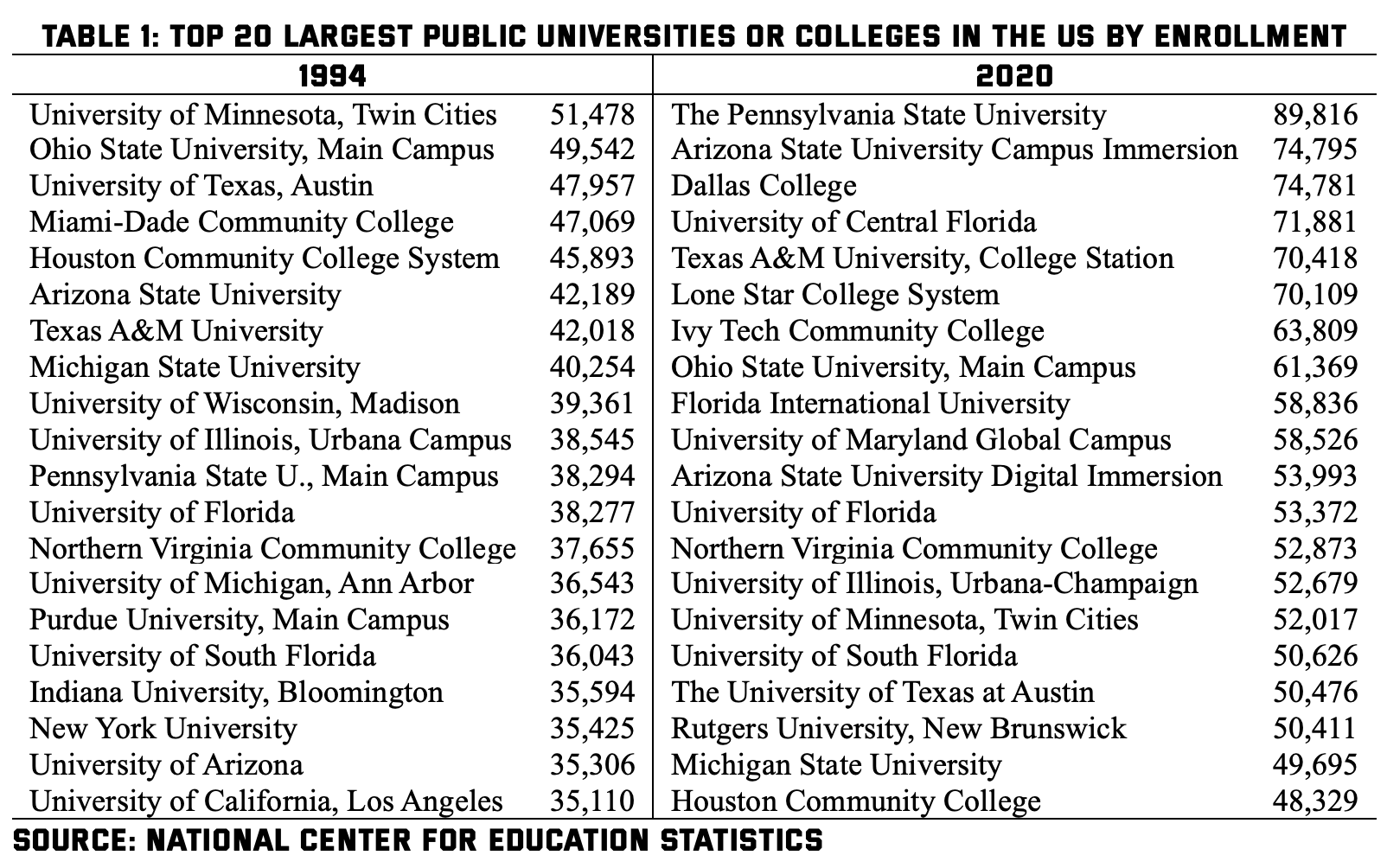
Lots of TX and FL.
An Adventure in Smoke Detection
Respectfully, how the fuck do smoke detectors work? Who invented them? Etienne Fortier-Dubois asks the same question and ends up hunting through obscure German pdfs and soliciting strangers who live near the Swiss National Library to find a book. Happy weekend to those who celebrate, indeed.
I won’t spoil the payoff, but the inventor of the smoke detector was originally trying to build a poison gas detector.
See also how the myth of phineas gage affects brain injury survivors (for the “is this story real?”) and how silica gel took over the world (for the physical things).
Australia’s State Capacity: A Literature Review
A big part, it turns out, is starting the flywheel of citizens having high expectations of government, and holding their government to those expectations.
I’m into insect welfare! What’s next?
I mean, who isn’t interested in weird new things on the frontier of applied ethics? I’m mostly filing this under “reality has an insane, incomprehensible amount of detail.” There are literally quadrillions of ants alone, every one of them a living thing. They sniff things with their little ant-y antennae and feel the warmth of the sun and explore the world in their little ant-y bodies. They feel pain when they’re stepped on and there really is something that it is to be an ant, even if we’ll never know it. This stuff is hard.
Your LLM-assisted scientific breakthrough probably isn’t real
People hear what they want to hear, and I guess a lot of people want to hear that they’re geniuses who’ve solved things “experts” could never figure out. Unfortunately, science is hard. The linked piece is a kind but direct plea to try falsifying your findings — or at least ask a different LLM (without memory turned on).
The piece also reminds me of Scott Aaronson’s Ten Signs a Claimed Mathematical Breakthrough is Wrong and Eight Signs A Claimed P≠NP Proof Is Wrong.
Wikipedia:Signs of AI writing
What it says on the label. Insofar as you can get a lot of the info as vibes by just interacting with LLMs (I certainly felt like I knew a lot of what was in here), I’d include this under the broad genre of “distilling tacit knowledge.”
Coin-cidence? Have cashless payments reduced the incidence of upper aerodigestive foreign body insertion? A study of UK Hospital Episode Statistics
The shift to contactless payments mean fewer kids eat coins.
A natural experiment on the effect of herpes zoster vaccination on dementia
The herpes zoster vaccine maybe prevents / delays dementia?? I love natural experiments. Yes haha yes put sharp cutoffs in your policies so we can do regression discontinuities:
in Wales, eligibility for the zoster vaccine was determined on the basis of an individual’s exact date of birth. Those born before 2 September 1933 were ineligible and remained ineligible for life, whereas those born on or after 2 September 1933 were eligible for at least 1 year to receive the vaccine. Using large-scale electronic health record data, we first show that the percentage of adults who received the vaccine increased from 0.01% among patients who were merely 1 week too old to be eligible, to 47.2% among those who were just 1 week younger. Apart from this large difference in the probability of ever receiving the zoster vaccine, individuals born just 1 week before 2 September 1933 are unlikely to differ systematically from those born 1 week later. Using these comparison groups in a regression discontinuity design, we show that receiving the zoster vaccine reduced the probability of a new dementia diagnosis over a follow-up period of 7 years by 3.5 percentage points (95% confidence interval (CI) = 0.6–7.1, P = 0.019), corresponding to a 20.0% (95% CI = 6.5–33.4) relative reduction.
Authority is a Tool
On Fran’s account, the best leaders:
- Use authority to protect the team.
- Bridge to other nodes of authority.
- Build social capital and then burn it (wisely).
Reminds me of Wayne Hsiung’s piece on learning from Harvard’s leadership crisis and Stay SaaSy on leading from the front.
Sunstone
I’ve been on a poetry kick, and I’ve found Claude does a pretty good job translating Spanish… that, or Octavio Paz is a great poet. Or both. The rhythm still comes across great in the English, so I’ll choose to believe it did a good job.
The Fake News About Fake News
Misinformation research is in a sorry state. Contrary to the book being reviewed, Daniel Williams argues that
The belief that a dangerous misinformation virus is a major source of society’s problems is popular not because it is supported by evidence, and not because it has duped credulous individuals, but, most plausibly, because its apolitical, technocratic, and simplistic character resonates with the interests and biases of those who consume and propagate it.
REVIEW: Storia do Mogor, bu Niccolao Manucci
Fools sometimes proclaim “my life is a movie!” Manucci, though, is an actual main character. Stows away, ends up on the other side of the world, talks his way into the court of the Mughal emperors. He ends up writing one of the best western sources on the history of India at the time, all while being an incredibly-unreliable narrator. Another 1,000-page book on my list.
GQ’s profile of Newt Gingrich:
Taken more because it puts Bill Clinton up in the ranks of historical superpersuaders:
Newt’s staff and the class of ’94 had seen it time and again: Every time Speaker Gingrich galloped into the Oval Office with his musket loaded for Slick Willie, he shuffled out holding his own gonads. “It got to the point where the Republican freshmen were afraid to send him in there alone,” remembers Newt’s archivist and friend, Mel Steely. “By the time Newt would get back to his office, Clinton’s press secretary had already announced the opposite of what they’d agreed on. I’d say, ‘Newt, how did you get suckered in?’ And he’d say, ‘Clinton would come up from behind his desk, put his arm around me, and say, “Newt, you’re absolutely right.” Just charm the pants right off of you.’ ”
I guess I was wrong about AI persuasion
Everybody assumes that a hypothetical superpersuasive AI will be like Bill Clinton above, though — it’ll just be able to argue / charm / hypnotize you into believing whatever it wants. I, like Dynomight, don’t buy that. Epistemic learned helplessness is a thing, and people will often just not change their minds even when presented with arguments they themselves deem persuasive.
But we’re obviously super-persuadable:
it [just] doesn’t happen because of snarky comments on social media or because some stranger whispers the right words in our ears. The formula seems to be:
- repeated interactions over time
- with a community of people
- that we trust.
A real superpersuader would be super honest and candid — always on your side and by your side. It’d be the youtube creator you watch when you get home from a long day at work, and it’d be beside you at work, too. People believe things as a function of what their friends believe.
# Travel time ~= 750 * distance ^ 0.6
Vitalik does some of the first vibe-coding I’m aware of (GPT 3.5! back in 2023!) to find a bunch of random places on earth, then calling the google maps travel time API. Turns out there’s a pretty clean power law! It even holds for the moon!
See also After 20 years, the globally optimal boggle board.
Why You can justify almost anything using historical social movements
Ozden argues that many social groups incorrectly believe they’re doing the one big right thing. I’m not fully sure why, but it evokes Feyerabend’s Against Method — there is no absolute method. You just gotta do your thing.
Will Musk and Trump go to hell for defunding the corporal works of mercy?
A rare exception to Betteridge’s law of headlines:
Jesus condemned the rich man to hell for ignoring the poor man Lazarus at his door. When Americans and their leaders stand before the throne of God, how will they be received?
At the Last Judgment, according to the Gospel of Matthew, those without compassion will be told, “Depart from me, you accursed, into the eternal fire prepared for the devil and his angels. For I was hungry and you gave me no food, I was thirsty and you gave me no drink, a stranger and you gave me no welcome, naked and you gave me no clothing, ill and in prison, and you did not care for me.”
They will ask, when did we not minister to your needs? And he will answer, “Amen, I say to you, what you did not do for one of these least ones, you did not do for me.”
If you believe the Scripture is the Word of God, the message is clear: Musk and Trump will go to hell for defunding the corporal works of mercy. Will we?
Youtube Videos I’ve liked
- John Bois on the development of telegraphy, told through the allegory of the ’90s sitcom Home Improvement
- Can goodness compete?. Classic Joe.
- Jacob Collier Improvises the National Symphony Orchestra.
- Visualizing transformers and attention. Classic 3B1B.
- Tales from the Coup: A great series from David Lombardo at the Albany Times-Union on the 2009 New York State Senate leadership crisis.
- The Evolution of Avalanche Mitigation in Utah. A little propaganda-ey, but still cool.
Misc
Channeling my inner Matt Levine, I’m dumping a bunch of great things that, through no fault of their own, aren’t getting a paragraph:
- Michelle Ma on social dark matter (a classic) and the AI race.
- If you’re reading me, you’ve already read Andy Masely on data center water usage. But his requests for journalists covering the topic are great for any aspiring science communicator.
- Gavin Leech on Chinese open-weight models and where we are, roughly, as 2025 winds down.
- Would Walter White Still Cook Meth in 2025? Since the show ran, both cancer treatment and teachers’ health insurance have both improved.
- The Galahad Principle: “My strength is as the strength of ten Because my heart is pure.” No one ever said “my strength is as the strength of eight because my heart is pure-ish”. Sometimes value only emerges at the end.
- Kwame Anthony Appiah has pretty bourgeois views in his NYT “Ethicist” column.
- How hard would it be to steal a papal election? Pretty hard.
- Power laws in book publishing — “the average book published today is selling less than 300 print copies over its lifetime in the US retail channels”!
- White tea, black tea, oolong tea, and green tea all come from the same plant!
- Lightning on demand.
- List of games that Buddha would not play.
- An oral history of natural language processing in the 2020s. It’s like the Dwarkesh book, but less Silicon Valley.
- The fastest fizzbuzz.
- Should people in the Rawlsian original position be longtermists?
- Julia Galef made lists of unpopular ideas about social norms and unpopular ideas about politics and economics. She isn’t necessarily endorsing them, and neither am I. But we should look them in the eyes.
- A bird plays an important role in Charlie’s Angels — and it’s the wrong bird. But maybe that’s good??
- How Alex Lawsen uses LLMs — see also Parker Conley on outsourcing self-control and Cate Hall against willpower.
- Charts lie, and how!
- Nigerian population estimates are probably off by ~5*10^7.
- A small guide to making nice tables.
- Horniness seems pretty responsive to placebos.
- Understanding Porn with Language Embeddings.
- Jasmine Sun’s exit interview from Substack.
- How do screens work?
- Dogs really do look and act just like their owners. Owls in towels.
- Homing pigeons fly by the scent of forests and the song of mountains.
- I wouldn’t risk death to watch a TV show… but a lot of North Koreans would.
- Yuxi Liu’s ideas for hard science fiction stories.
- Sometimes, curing easily-curable diseases costs the government money on net, because then the people collect government benefits for long enough that it would’ve been cheaper for the government not to cure them. (Of course, this just means the government shouldn’t make decisions based purely on what’d save them money. One man’s modus ponens…)
- Old Scav lists.
- Why Peter Thiel thinks effective altruism is the antichrist (not a joke).
- Reasons and Persons, but only the thought experiments.
- Declassified CIA analysis estimates “the possibility of a war between India and Pakistan in this decade [i.e. 1990-2000] as about 1 in 5.”
- The NIMBY Christmas Cinematic Universe.
- Ideas are getting harder to market, not harder to find.
- Sasha Chapin on his journey to becoming a normal person.
- Stable attention as a prererquisite for skill.
- How LLMs grok (no, not that grok). I love distill.pub and its children!